
Council OKs updated fire hazard maps from state
By SARA HALL
City Council last week unanimously approved Cal Fire recommendations for the 2025 fire hazard severity zones for local responsibility areas.
Councilmembers voted 5-0 on June 10 in support of the introduction of an ordinance amending city code to incorporate the new FHSZ maps issued by Cal Fire in March. They identify areas of moderate, high and very high fire hazard.
The 2025 update to the map “significantly expands” upon the last revision from 2011, said Fire Marshal Robert Montaghami. Although the “very high” FHSZ area decreased from 4,999 acres to 4,897 acres, the map now classifies 341 acres as “high” and 201 acres as “moderate.” The largest expansions concentrate in the coastal area of North Laguna, inland areas of Downtown and portions of South Laguna.
A key improvement is the analysis of ember travel and how fire spreads into the neighborhoods, he noted.
“As a result, we have received a more accurate, long-term view of wildfire hazard potentials in our city,” he said.
The maps are a tool in California’s wildfire preparedness and land use planning, Montaghami said. They help guide building standards, defensible space requirements and emergency response planning.
“The fire department evaluated the updated hazard severity zones and concurs with the Cal Fire recommendations, finding them appropriate for Laguna Beach’s local risk profile without requiring additional designation,” he concluded.
Local governments are required to adopt these maps by ordinance and designate the severity zones. State code does not allow cities to decrease the level of hazard; however, the local agencies can increase or expand the FHSZ areas based on local conditions.
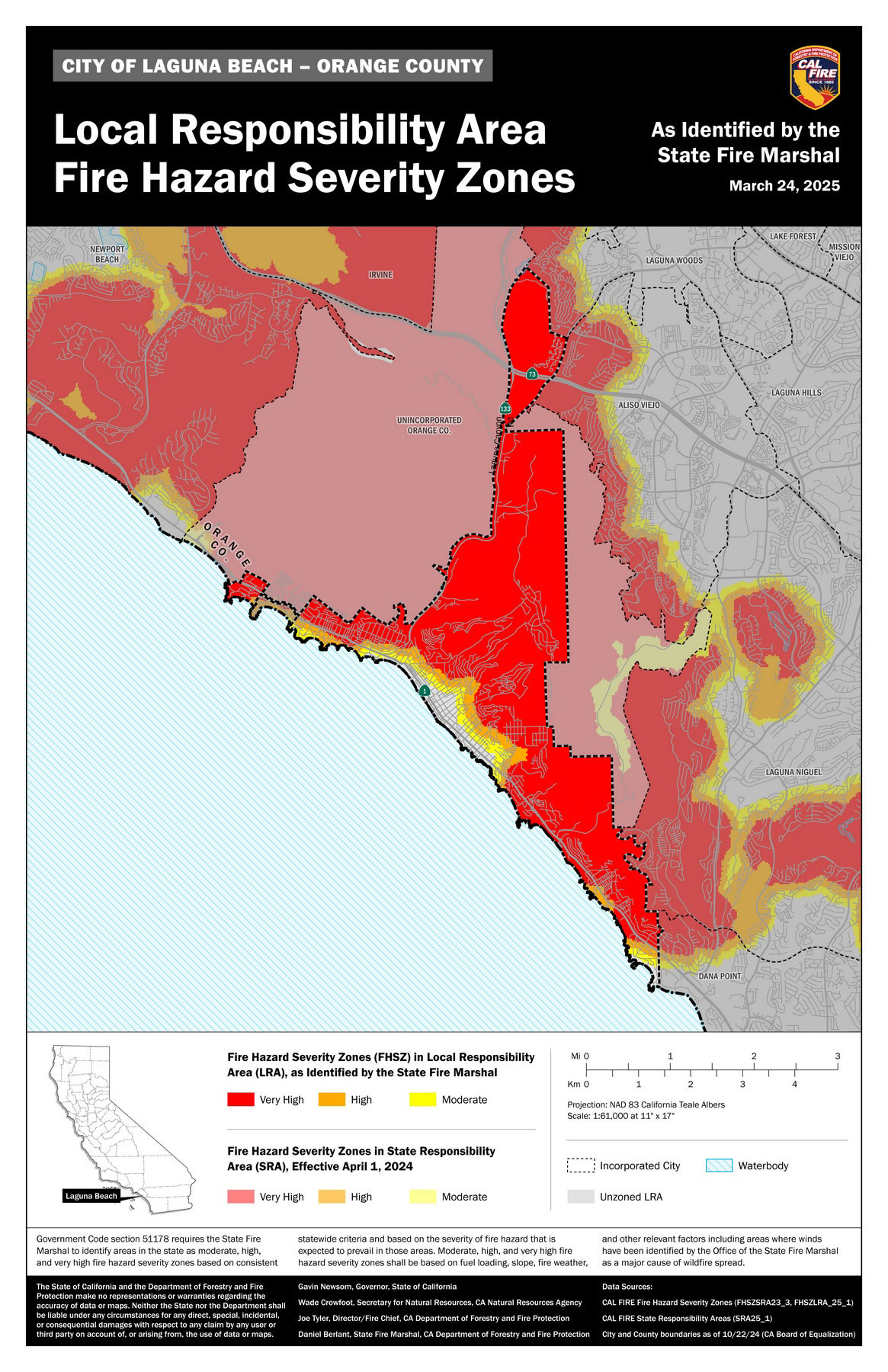
Click on photo for a larger image
Courtesy of Cal Fire/city of Laguna Beach
The new 2025 fire hazard severity zones map for Laguna Beach
Based on the updated maps, properties located within the high and very high FHSZ become subject to state-mandated building requirements, Montaghami said. California building code requires fire-resistant building standards for new construction of major renovations, like ember proofing venting, ignition resistant materials and multi-pane windows. Those example conditions are already required in the city, he added.
Montaghami explained that homeowners within the high and very high FHSZ must now comply with the vegetation management and defensible space requirements established under two other laws:
–AB 38 requires property sellers to complete a brush clearance inspection and provide documentation to the buyers confirming compliance with home hardening features prior to the close of escrow.
–AB 3074 establishes an ember resistant zone (called “zone zero”) within five feet of a structure, requiring removal of combustible materials like decorative structures, landscape materials and potted plants.
Councilmember Bob Whalen also noted that AB 38 allows the buyer to assume the requirement for the brush clearance within 12 months.
The law is essentially a disclosure requirement, Montaghami confirmed. The seller has the obligation to obtain an inspection and provide that report as part of the real estate transaction. Although there’s no enforcement mechanism for the fire department to follow up, it provides a civil recourse for the buyer, he noted.
Although it often doesn’t happen, Whalen commented, the 12 months go by and no brush clearance is done.
City Council could adopt a local ordinance giving LBFD authority to enforce and follow-up, Montaghami noted, answering a council question.
“We can always be more restrictive than the state law,” Montaghami said.
Also, the “zone zero” is going to be a big deal for the entire community, Whalen commented. It’s going to be applicable to all homes within the high and very high hazard severity zones, which is a “substantial” portion of the city. It essentially means nothing between zero and five feet from the house, he explained.
Click open story button to continue...
Local resident and landscape architect Ann Christoph disputed the difference between dry brush and irrigated landscaping, arguing the city has the authority to distinguish between the two and what would be required to clear away.
“It’s a tremendous impact on ordinary homeowners who have very little land – usually – to provide beautification around their houses, to require them to have a desert zone of five feet continuously around their house, when maybe that’s all they have,” Christoph said.
There is a “huge difference” between irrigated, maintained landscaping and dry brush, agreed Councilmember Hallie Jones.
“I think we, as a council, are educated enough on these fire issues that we understand that and our hands are going to be tied by what the state mandates, but we need to be cautious,” Jones said.
Whalen emphasized that the city does not have the discretion to make that decision in the “zone zero” rule.
“This is not locally imposed, this is coming down from the state,” Whalen said.
City Manager Dave Kiff agreed that the public speakers made some good points.
“I’d encourage you not to shoot the messenger,” he said.
The city isn’t going to authorize people to be the “five-foot clearance police,” Kiff commented, but a lot of the story is yet to be told as the city isn’t entirely in control of the state-mandated rule. As with other issues, they will work through it, he added.
He also worries how insurance companies will react, including refusing coverage or not paying a claim if a home isn’t complying with the zone zero regulations.
The insurance companies are going to drive this, agreed Councilmember Sue Kempf.
“They’ve already said they’re doing this catastrophic modeling and if you don’t do clearance around your house, you might not get insurance,” she said.
Jones noted that many of the public comments she’s received don’t agree with the changes. Although that’s not something they have control over, she asked about potential recourse for people who want to take this up at a higher level.
All of the public comment will be provided to the state fire marshal’s office, Montaghami answered.
“Cal Fire being the leading agency that really drives this law, I think it would be great at the state level for residents of our community to reach out to the Cal Fire’s state fire marshal’s division,” Montaghami said.
Click here to see a PDF of the new 2025 FHSZ map for Laguna Beach and click here to view a statewide interactive map.
~~~~~~~~
Sara Hall covers City Hall and is a regular contributor to Stu News Laguna.