
Alex Anderson is dedicated to her role as gatekeeper of our natural resources
By DIANNE RUSSELL
Photos by Mary Hurlbut
In her role as PORTS (Parks Online Resource for Teachers and Students) Interpreter for California State Parks, technically, Alex Anderson’s classroom is outside of Cottage #13 at the southernmost point in Crystal Cove State Beach. With her back to the ocean and Crystal Cove’s mysterious and magical tidepools, Anderson describes it as a “living museum.”

Click on photo for a larger image
Alex Anderson has been a PORT Interpreter for three years
For someone who once considered being a librarian, this seems world’s away from that occupation – or maybe not. In much the same way as librarians serve as liaisons of knowledge, Anderson serves as a bridge to understanding the natural environment.
“I think you have to understand something to love it, and that love translates into protecting it,” she said.
Anderson started with California State Parks 10 years ago and credits her mentor Crystal Cove State Park’s Interpretative Naturalist Winter Bonnin for supporting and nurturing her passion.

Click on photo for a larger image
As a PORTS Interpreter, Alex Anderson educates the public about the natural and cultural resources in the park
“Our job as interpreters is to bring meaning to the natural and cultural resources in the park,” Anderson said, “so that hopefully people make connections and create memories – and that’s how they’re going to learn to love these resources and want to protect them.”
To that end – along with several other projects – Anderson presents 45-minute online programs to students, grades K-12. “I love where I teach,” she said. “It’s Cottage #13 in Crystal Cove. I set my equipment up on the deck, right in front of one of our tidepool locations. During the presentation, students have a live view of the ocean and tidepools. It’s a great resource for kids who can’t get to the beach. I’ve been thinking lately about access to the park and ocean and focusing on reaching people virtually who don’t have access. It’s a way for landlocked schools to get a live view of the coastline and make a connection.”
Anderson brings the diversity of State Parks directly into the classroom no matter where the students are. “I do virtual field trips for K through 12 and I do two programs that offer tidepool animal adaptations. I just recently created a program solely on octopuses. I’m obsessed with them.”

Click on photo for a larger image
Alex Anderson in her office with artifacts from the area
She also has a partnership with CHOC, Children’s Hospital of Orange County. “I deliver PORTS virtual field trips to patients in CHOC’s Cherese Mari Laulhere’s youth inpatient psychiatric facility,” she said. “It’s a very meaningful partnership to me. The patients are ages 3-17 and they have a classroom in the hospital.” Anderson works with their education staff to offer a live view of the coastline for the students. The goal is to let the students know that when they leave the hospital there is an accepting and enriching world waiting for them to explore in California State Parks.
“I love that partnership with CHOC, which I do every Tuesday, and then on Thursdays I do my programs for K through 12 schools for any teacher who’s signed up (via the PORTS website ports.parks.ca.gov),” Anderson said.
They have a new blended program which includes both digital and in-park experiences.

Click on photo for a larger image
Outside Cottage #13
“I’m also a member of the Orange County Marine Protected Area Council OC, our local branch of the people who work with marine protected areas within the county, so we have different teams within OCMPAC.”
Click open story button to continue reading...
Initially, Anderson helped with the Coastal Cleanup events (which collected 150 lbs. of trash a few weeks ago), and then she became a Marine Protected Area Educator. “A lot of my career here at State Parks has been educating the public about our Marine Protected Areas. I am obsessed with them – there are 124 along the coastline and they have different rules and regulations. Here at Crystal Cove State Park, we have a State Marine Conservation Area (USMC), which is different from Laguna’s reserve.”
Anderson explained the difference. “In a reserve like Laguna, there’s absolutely no take of any kind, but here at Crystal Cove you can go spear fishing, you can go fishing from the shore and put out lobster traps. It just has different rules, but absolutely everything in the tidepools is protected.”
Working for the education team for OCMPAC, Anderson and Bonnin are co-chairs. “We’re the leads and create different projects to promote outreach of Marine Protected Area education.” As an example, they hosted a speaker series for all existing tidepool volunteers in Orange County at the OC Sailing and Event Center at Dana Point Harbor. “We got a bunch of speakers together to talk about topics that are relevant for the volunteers who are on the rocks in Orange County protecting the tidepools,” she said. Anderson added that she’s a big fan of the Laguna Ocean Foundation. “They do so much for our community.”
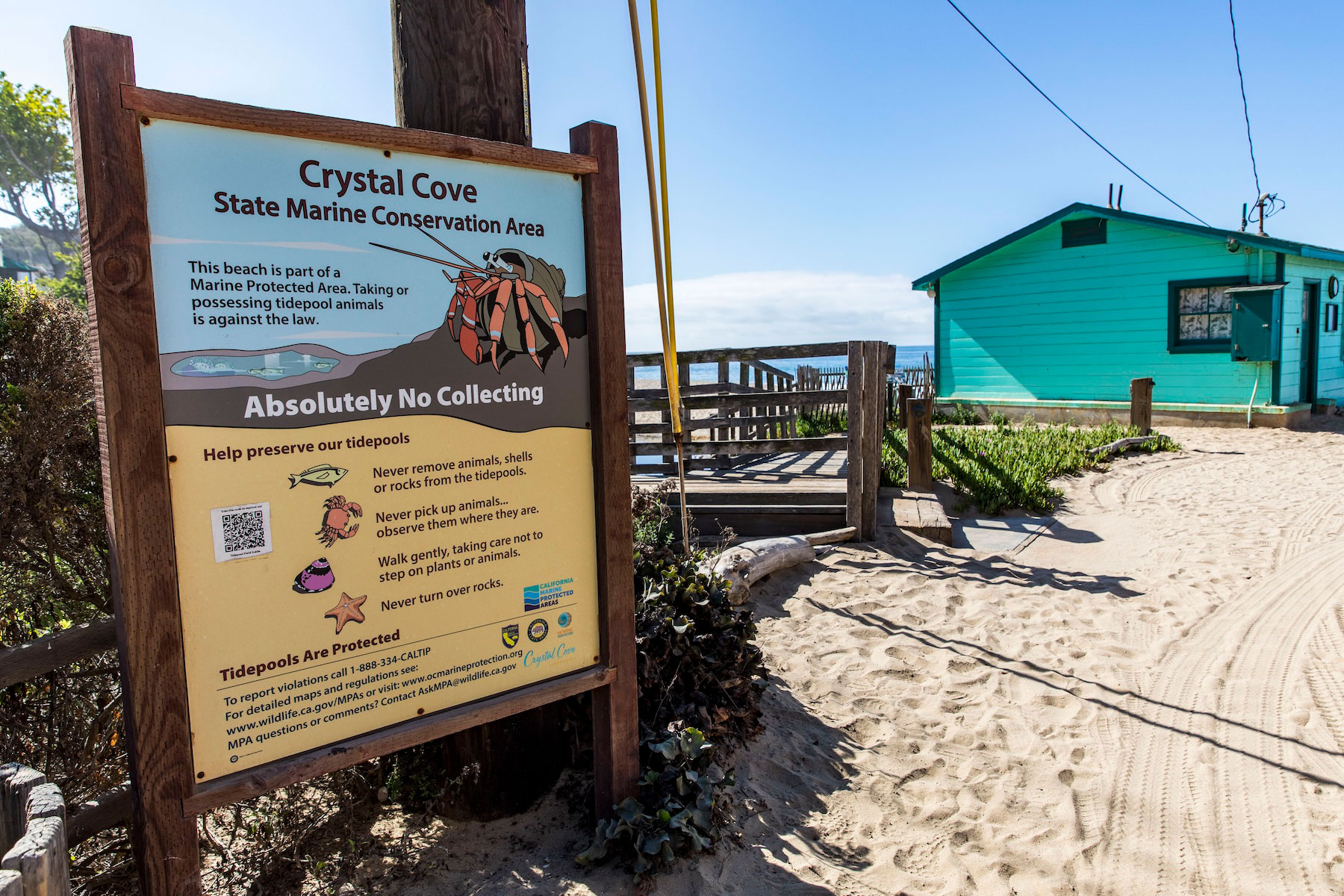
Click on photo for a larger image
Entrance to Crystal Cove with information sign and tidepool rules
The State Park now has a MPA (Marine Protected Area) mobile-type pool cart that park aides pull out on Saturdays next to the MPA sign with the tidepool rules. “I just want people to walk away with the four good tidepool rules (on the sign),” Anderson said. “We have shells and props and information to educate people – they can touch the shells and hopefully they don’t touch them when they get to the beach.”
In partnering with Crystal Cove Conservancy, California State Parks works arm-in-arm to steward the park’s 2,400 acres of backcountry, 3.2 miles of coastline and offshore underwater habitat.
CCC’s mission is to restore the park, educate future environmental leaders and protect Crystal Cove, and places like it, for generations to come.
The State Park collaborates on a multitude of programs. In October alone, Crystal Cove offered a guided beach and tidepool walk, a perimeter of the park hike, an autumn bird walk, a tidepool stewardship program, coastal ecology, tour of the Historic District and trail assistant program.
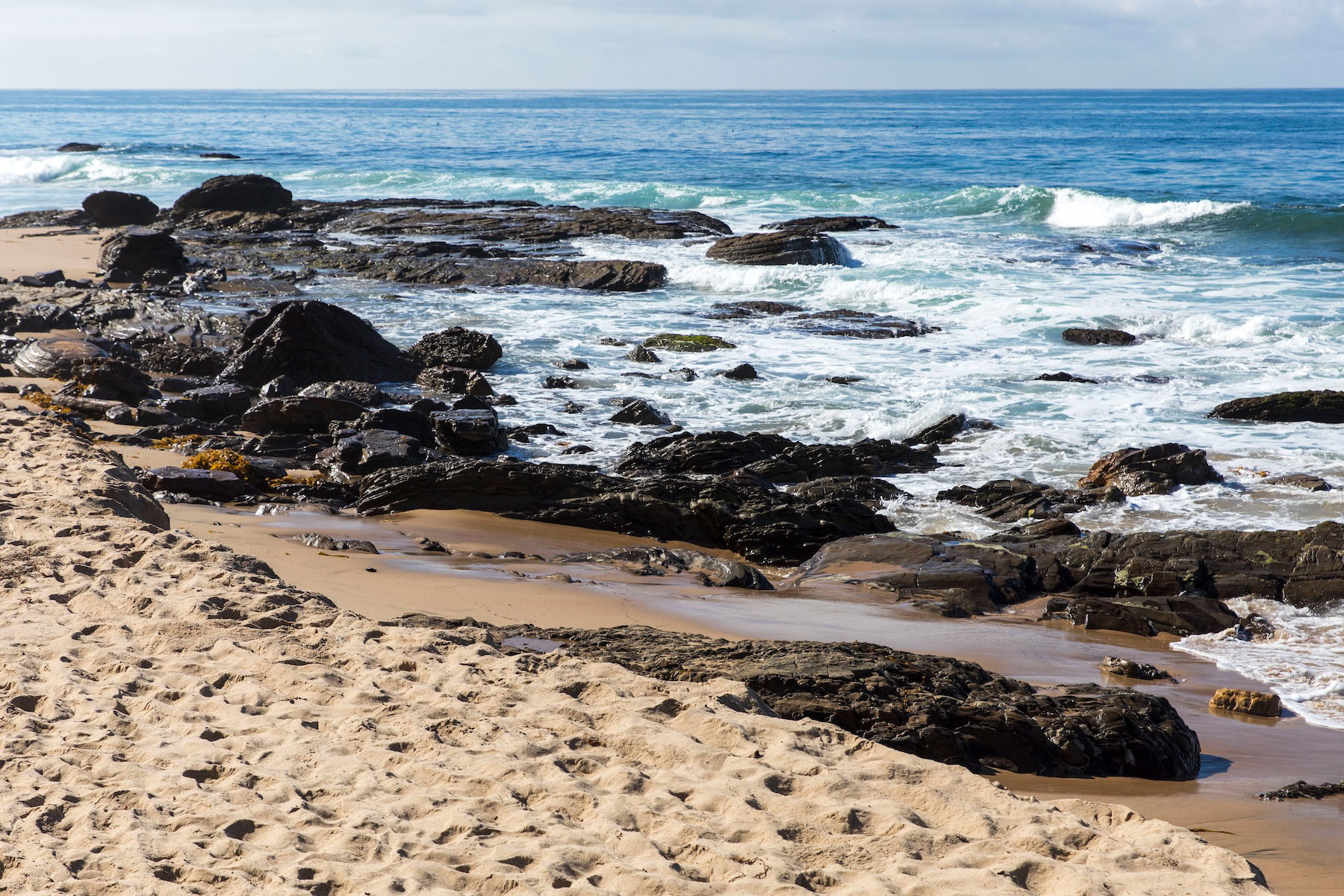
Click on photo for a larger image
Tidepools are protected at Crystal Cove and there is a no take policy
Anderson became a resource gatekeeper naturally. “I grew up here and I love it. I’m trying to protect what I love. My dad raised me to really appreciate it.”
Born in Laguna Beach, her dad, Dr. Bill Anderson, owned and operated Sleepy Hollow Walk-in Family Care for 30 years. (Alex) Anderson still loves Sleepy Hollow; it is her “heart beach.” No matter what the weather, her dad swims every day in the ocean in front of it.
Her family lived in Big Sur for a short period while her dad commuted to Hollister to work in emergency care. “My early years in Big Sur informed my passion for ocean,” she said. They eventually moved back to Laguna.
Anderson went to school in Chicago at DePaul University and San Francisco University and has a degree in English Literature. Putting her degree to good use, she manages social media for the State Park.
She notes that her two favorite authors are Joan Didion and John Steinbeck.
Steinbeck believed that the fate of people and their environment is intertwined, and for Anderson it appears to be true. “The landscape where you grow up can impact your life,” Anderson said. “I feel that’s part of my story – ending up back where I’ve always had this passion for the ocean and for tidepools and the environment. I feel like I found my way back to where I need to be and found my place educating people about the place that I love so much. When you’re an interpreter, the whole point is wanting the person you’re educating to walk away with a conservation ethic.”
For more information about Crystal Cove State Park, go to www.crystalcovestatepark.org/.