

Riding the endless wave: Laguna’s Dick Metz returns to where it all started
By DIANNE RUSSELL
Photos By Mary Hurlbut
As Grand Marshal of the 2026 Patriots Day Parade on March 14, Dick Metz has a lot to celebrate. At 96, Metz is still riding the momentum of a life shaped by saltwater and serendipity. Raised in Laguna Beach, Metz came of age alongside the pioneers of modern surfing, forging a lifelong friendship with Hobie Alter and eventually owning 22 Hobie surf/sports shops. Widely regarded as the real-life inspiration behind Bruce Brown’s 1966 film The Endless Summer, Metz helped define the golden era of the sport.
Even now, this local icon continues to shape the story of surfing. As founder of the Surfing Heritage and Culture Center (SHACC), Metz is eagerly anticipating the re-opening of the museum in its permanent location on Broadway Avenue. (It was previously in San Clemente.)

Click on photo for a larger image
Dick Metz wears polarized sunglasses designed by Hobie Alter
In a staggering collaboration of Laguna legends, Metz, along with SHACC Board Members Mark Christy, Jeff Alter, Greg MacGillivray, Paul Naude, Patti Paniccia, Randy Hild, Dan McInerny and Royce Cansler brought a dream to fruition by securing the former Downtown Laguna Beach location of Laguna Drugs.
Returning to the place it all started – the SHACC is a mere half a block from Main Beach boardwalk where his dad owned the Laguna Diner housed in an old railroad car and then the Broiler restaurant – Metz has come full circle.
Raised in Laguna Beach during surfing’s formative years, Metz grew up in a tight-knit coastal fraternity that included close friend and fellow Laguna standout Peanuts Larson. Together they were part of the small but adventurous cadre of postwar surfers who helped define Orange County’s early surf culture. Metz also forged a lifelong friendship with Hobie Alter and moved within the same circles as innovators like Dale Velzy and stylist Phil Edwards. As his travels took him to Hawaii in the 1950s, Metz formed bonds with legendary watermen including Peter Cole and later crossed paths with big-wave charger Greg Noll.
That generation’s shared exploration – from Laguna’s reefs to Hawaiian swells – helped shape not only Metz’s legendary wanderlust, but the golden era of California surfing itself.

Click on photo for a larger image
Metz and his three-year journey around the world from 1958-1961 inspired the film “Endless Summer”
Few are left to tell the story of early Laguna, and Metz is a revered and precise memory keeper. He was born in 1929 – just two years after the city was incorporated and on the brink of the Great Depression. “There was no hospital here, so I was born in Pomona, and then came right back here.”
By an earlier twist of fate, an unpaid meat bill prompted his parents move to Laguna.
“My parents (Carl and Edna May) went to high school together, then to Pomona Jr. College and both got teaching degrees (which back then took two years). My mom became a teacher in Big Bear, and my dad ran the Safeway store.” But his dad wanted to have his own business and through his meat salesman, the senior Metz found out a restaurant in Laguna could be bought by paying their overdue meat bill. “So, my dad went to L.A., paid $137 and got the restaurant,” he said. “My mother was an elementary school teacher here in Laguna for years.”

Click on photo for a larger image
The Broiler, with a bar, restaurant and dance floor, was on the boardwalk. Later it was taken down by the city since the row of buildings blocked the “window to the sea.”
As time went on, Metz became part of the burgeoning surf scene. “The local surfers built a shack on the sand from the wood salvaged from the destroyed pier, and we hung out there,” he said.
At a young age (12), he learned bartending at his dad’s restaurant while the senior Metz was out doing errands. As the years went on, this skill served Metz well – he surfed during the day and tended bar around town at night.

Click on photo for a larger image
Metz is a prolific storyteller and respected keeper of Laguna’s early history
Metz recalls the day WW II started: “As a young teenager living on El Camino Del Mar, I was riding my bike at the corner of Legion and Glenneyre streets when people suddenly ran out of the nearby church shouting that the country was at war and that Pearl Harbor had been bombed,” he said. Not fully understanding what Pearl Harbor even was at the time, he rode home to ask his mother, who confirmed the news – it was December 7. In the days that followed, he recalls that everyone enlisted in the military, including his father. The upheaval deeply affected his family as well; shortly afterward, his mother filed for divorce.
Click open story button to continue reading…
During high school, Metz excelled at track, almost making the Olympic team, and his talent resulted in a scholarship. He first attended Chaffey College, then the University of Redlands, got a bachelor’s degree from the University of Santa Barbara, went to grad school in Mexico City and then attended grad school in Hawaii. “College was where the girls were,” he admitted.
Click on photo for a larger image
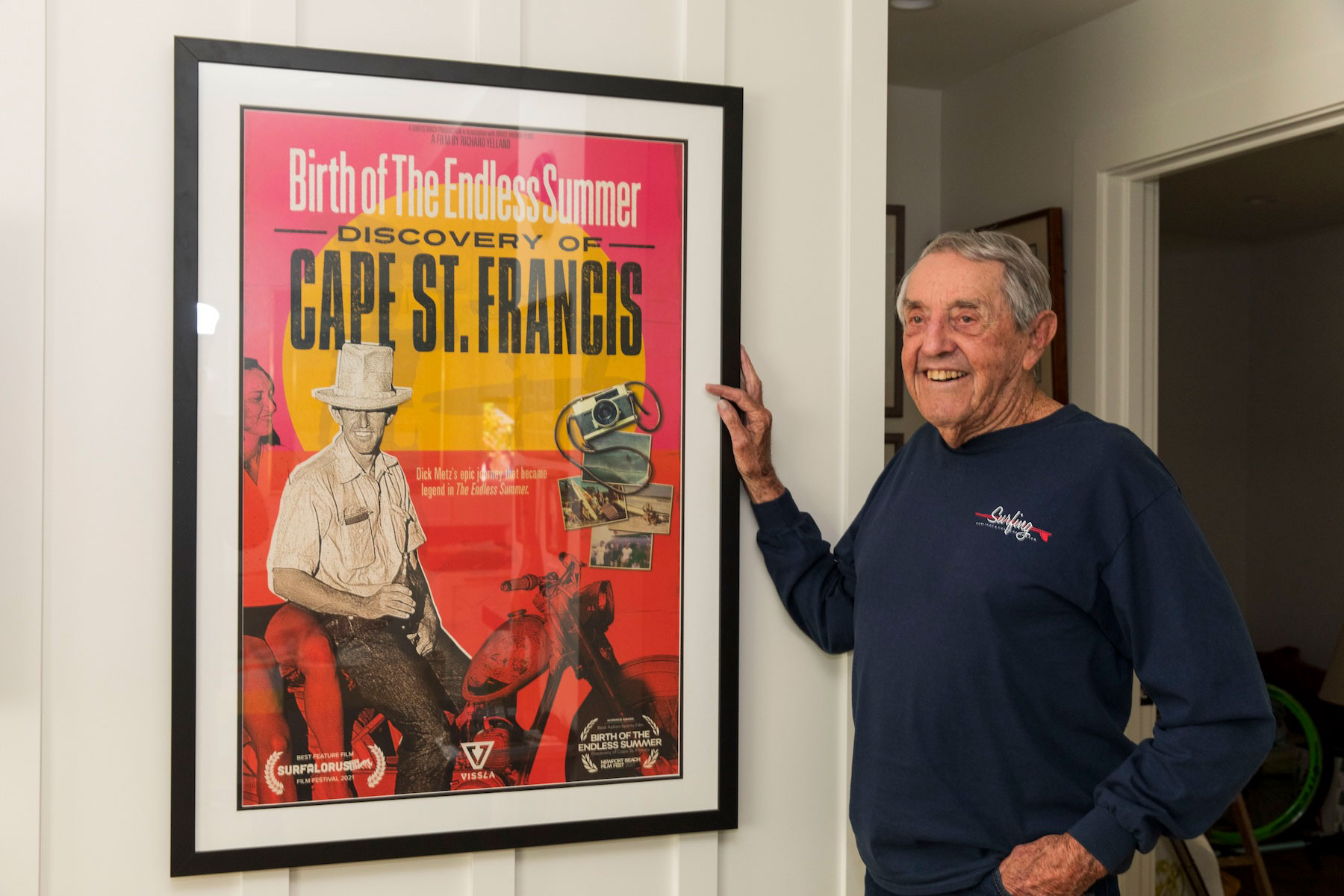
Californian surf pioneer Dick Metz vagabonded the globe from 1958 to 1961, leading to his discovery of the perfect wave in Cape St. Francis, South Africa. In “Birth of the Endless Summer,” 90-year-old Metz goes back to South Africa to retrace the steps of his original journey.
After college, Metz returned to Laguna Beach in 1954 where he tended bar, ran his father’s liquor store and repaired surfboards.
He soon forged a friendship – and eventual partnership – that would flourish beyond his wildest dreams. “Hobie (Alter) grew up in Ontario, Calif. I was five years older, so I was a college freshman at Chaffey and Hobie was a freshman in high school,” Metz said “I met him in Ontario because my best friend lived next door to Hobie. Later, when Hobie graduated from high school, his dad bought a summer house on Gaviota. I lived at Brooks Street for 20 years, so one day Hobie was down at the beach, and I remembered him and we talked. Hobie made 88 boards in that Gaviota garage.” That’s when the senior Alter bought a 1,500-square-foot space in Dana Point for Hobie to build boards.
“They were his creations, and I sold them,” Metz said. “He was like Thomas Edison; he was a genius at building things.”
In 1954, Metz helped with the launch of the first Hobie Surf Shop in Dana Point. “I had started surfing on redwood boards, then it went to balsa boards and then to foam boards, so Hobie was right in the crux of all of that,” Metz said.
By the late 1950s, surfboard design was undergoing a revolution. Early foam boards were made from Styrofoam – soft, fragile and difficult to shape. Around 1958, experimentation began with polyurethane foam, a tighter, more workable material. It took until 1961 to perfect the formula, but once dialed in, foam boards became the industry standard – and remain so today.
Click on photo for a larger image
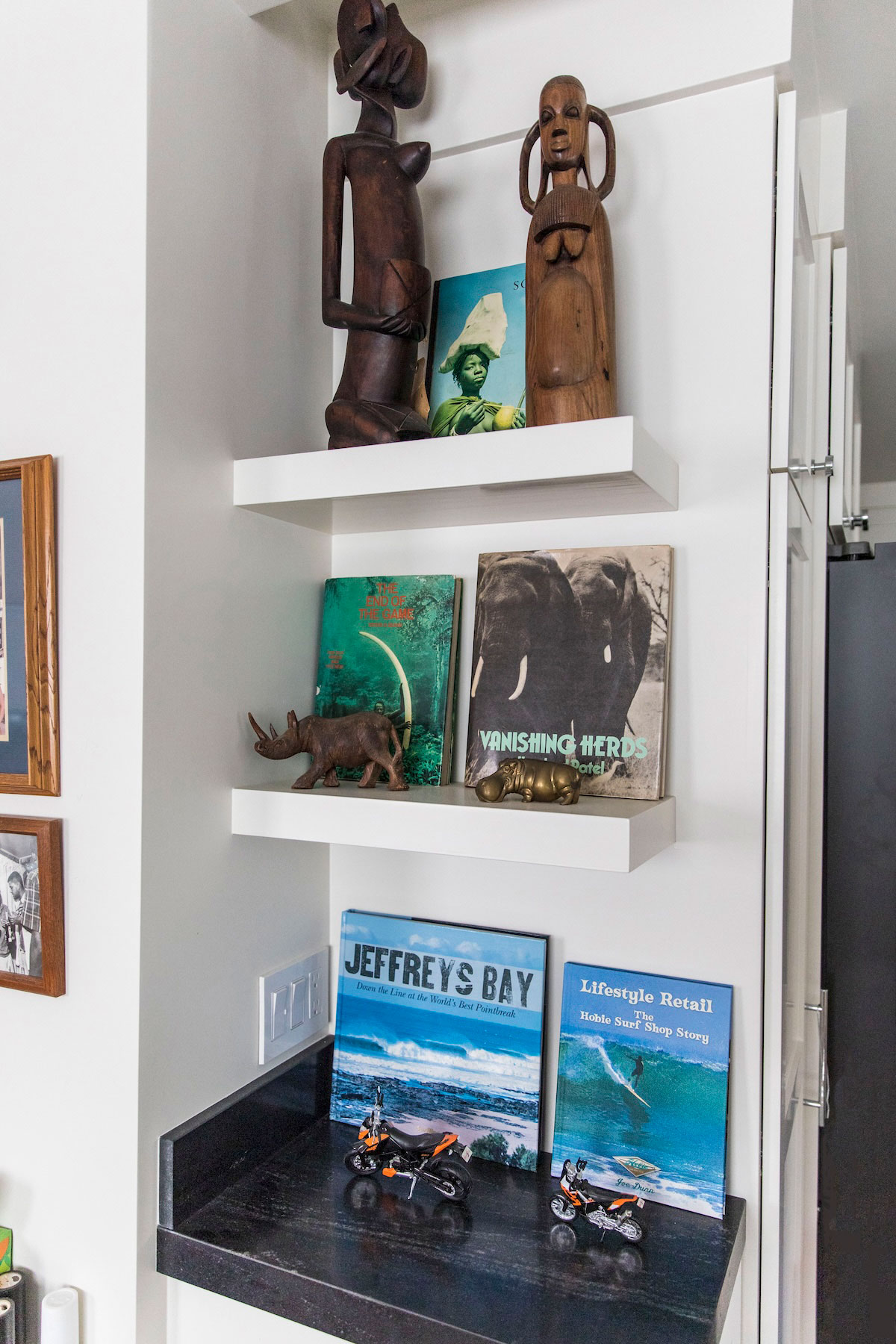
Some artifacts from traveling and a collection of books
However, the impulse to travel grabbed Metz, and a three-year trip around the world began.
“I’d been in college seven years, and my dad, who felt it was time to work, put me in charge of his liquor store in Huntington Beach. It failed because I was always surfing.” Metz dreamed of going to the South Seas after reading True and Argosy magazines, where the islands were beguilingly portrayed with photos of bare-breasted women. After a steady diet of bologna sandwiches and living at the liquor store – to try and save it – he couldn’t deny the wanderlust any longer.
“I sold the liquor license to Disneyland, paid off the store debts and with the remaining $1,900 bankrolled my trip to Tahiti,” he said. “I hitchhiked from The Sandpiper on Coast Highway to Panama.” He then spent 17 days with French Legionnaires in the hole of a freighter until it dropped him off in Papeete, Tahiti.
During his 1959-1960 trip to South Africa, Metz explored the coast with local John Whitmore, discovering the “perfect wave” at Cape St. Francis. His adventures inspired Endless Summer.
When Metz returned home during that transitional period, he planned to slip back into a simple routine – working for Hobie during the day and surfing whenever he could. But Hobie had other ideas. He suggested Hawaii.
Having previously lived and attended school there, Metz knew the islands and the local surf community well. So, he went – and what was meant to be a short stint turned into a 20-year chapter of his life.
From Hawaii, Metz began building something much bigger than he’d imagined. While Hobie focused on manufacturing surfboards in California, Metz expanded the retail side of the business nationwide. With not even a handshake agreement – no contracts, no paperwork – Hobie told him, “Use my name. Do whatever you want. If it’s good for you, it’ll be good for me.”
He took him at his word.
Over the next four decades, Metz opened and owned Hobie-branded stores across the country – in Laguna Beach, Santa Cruz, Santa Monica, San Diego, Colorado, Florida and beyond. Though they carried the Hobie name, the stores were his, operated under his own corporations, most notably Hobie Sports. They weren’t just surf shops; they were full sporting goods stores, even carrying skis during the winter years.
“Over the years, Hobie would get bored. He’d get about 95% into building something and he’d say to me, ‘I’m tired of making this, I want to do something else,’” Metz said. “I’d pick up all the pieces and make a company out of it and then I’d sell it or run it or do something.”
After roughly 40 years in the business, Metz decided it was time to step away. He sold the stores – more than once. In fact, several buyers went bankrupt, and each time the business found its way back to him. After multiple sales and recoveries, he finally exited for good, closing a remarkable entrepreneurial chapter built largely on trust and instinct. Mark Christy took over the stores in Laguna and Dana Point.
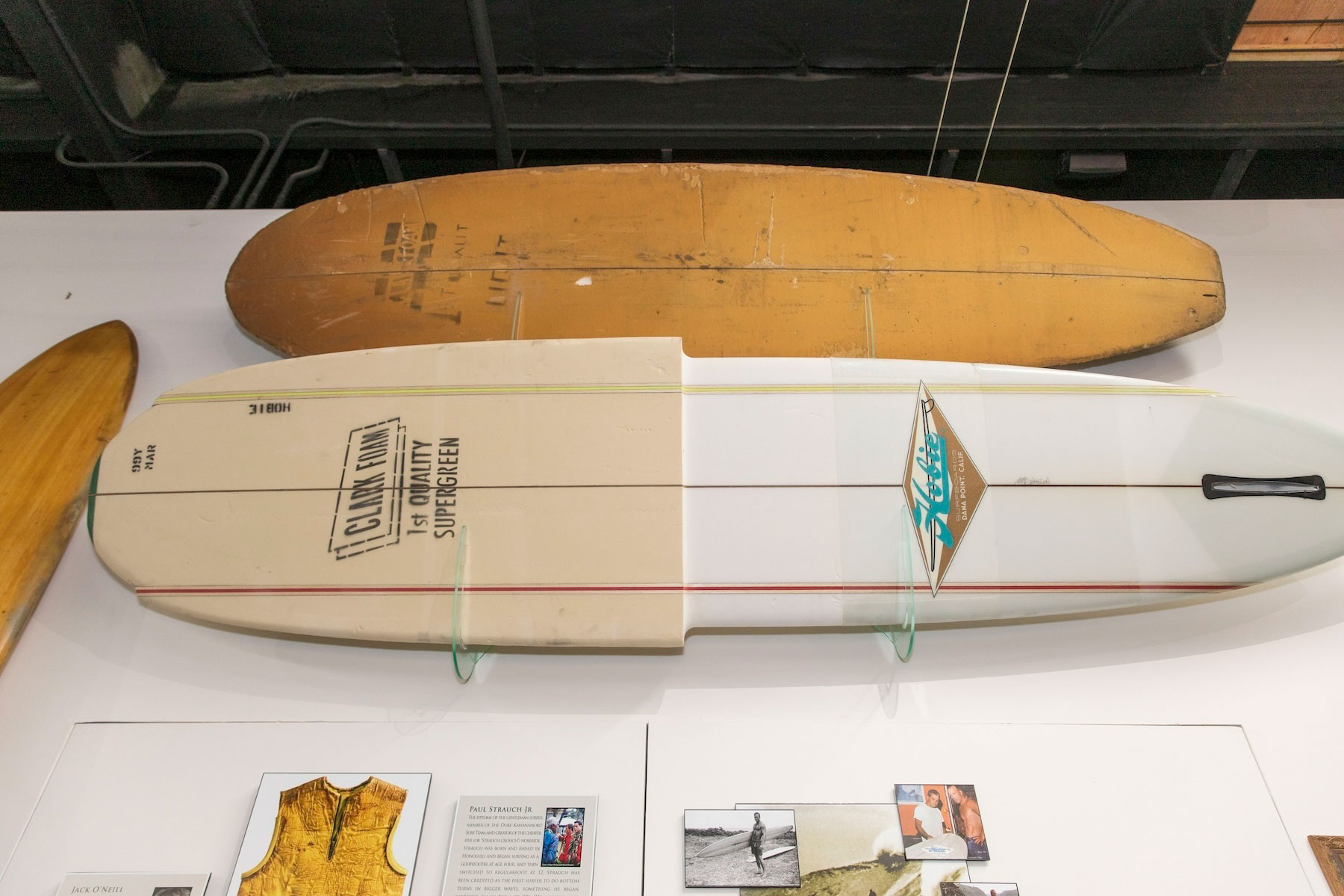
Click on photo for a larger image
Boards in SHACC’s original location in San Clemente
After living in Hawaii and collecting surfboards over the years, Metz realized no one was properly preserving surfing’s history. When local museums showed little interest or expertise, friends like Steve Pezman and Bruce Brown encouraged him to start his own museum.
In 1998, he began modestly, renting a desk in an office above the Royal Hawaiian restaurant, buying his first computer, securing a tax ID and establishing a nonprofit. The collection eventually moved to a warehouse in Costa Mesa, and later, with financial help from Spencer Croul, into a building in San Clemente near The Surfer’s Journal and Surfer Magazine.
As many early surf pioneers – including Surfer Magazine founder John Severson – passed away, he realized countless historic surf photos were left unidentified. “The younger generation didn’t recognize the people, places, or stories behind them,” Metz said, so he took on the painstaking, full-time task of identifying surfers, dates and locations, preserving vital pieces of surfing’s legacy.
What began as an archive to safeguard history gradually evolved into a full-fledged museum after growing public interest – especially from younger surfers – transformed it into a living tribute to the sport’s roots.
Metz contributed the vision, initial funding and first objects to the Surfing Heritage and Culture Center. Jeff Alter serves as executive director. Central to the mission, Metz has since donated his estate which includes his extensive surfboard collection and a great variety of surf memorabilia to the museum.
As for the relocation to Laguna, Metz said, “It made a lot of sense. I grew up in Laguna, and I wanted to be here. I’ve lived in Hawaii, Africa, Aspen and Idaho and now the SHACC is right across the street from where I grew up at Main Beach. It’s kind of a 360. I’m back where I started.”
Metz feels that SHACC is a gift to Laguna and will revitalize the Downtown. “Between SHACC, the Rivian and the Promenade, we’re going to have a triangle, and it will change the dynamics. Broadway will come alive because of the foot traffic and events.” SHACC will have a beer and wine license and finger food.
With all his accomplishments, one might think Metz is resting on his athletic laurels, so to speak, but he still races kayaks that can either be pedaled or paddled – and rides dirt bikes on the elk trails in Sun Valley, ID. “I rode all the way to Canada from Sun Valley on elk trails, never on pavement.” But he no longer surfs. “It’s my knees. You have to pop up in surfing; I can get up gradually but not fast enough. As you get older you just don’t react quickly and surfing is all about quickness.” (He still exercises every morning to stay flexible.)
On March 14, look for Grand Marshal Dick Metz as he leads the Patriots Day Parade down the streets where his incredible life of adventure began – and remarkably still continues.